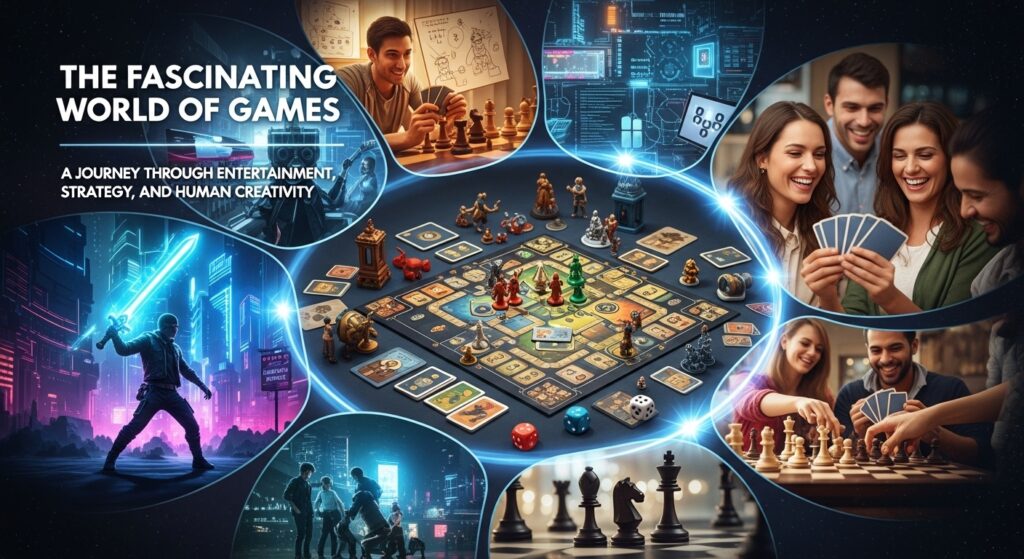
Games have been a part of human civilization for as long as history can recall. From the simple board games of ancient times to the advanced virtual worlds of today, the concept of playing games has evolved alongside humanity. Games have always represented more than just entertainment. They are reflections of culture, creativity, intelligence, and sometimes even conflict. The fascinating world of games stretches across centuries and cultures, adapting to technology and society’s changing desires.
In this detailed exploration, we will journey through the world of games, their types, evolution, social influence, psychological impact, and the endless creativity they inspire. Whether one talks about outdoor sports, classic board games, or modern video games, the essence of play remains an inseparable part of human life.
The Origins of Games: Play in Ancient Civilizations
Games began as a form of storytelling, teaching, and social bonding long before they became a global industry. Ancient Egyptians played Senet, a board game symbolizing the journey of the soul through the afterlife. The Chinese developed Go, a strategy game still played competitively today, while the Greeks organized athletic competitions to honor their gods. These early games were often deeply spiritual or educational, providing both relaxation and reflection.
Games were also used to train warriors and thinkers. The Roman gladiatorial contests, though brutal, were a form of entertainment and demonstration of strength. In ancient India, the game Chaturanga—a precursor to modern chess—was used to teach strategy and leadership. Through these examples, we see that games were not merely for leisure; they were a mirror of the society’s values, a way to express intelligence, and a tool for preparing individuals for real-life challenges.
The Evolution of Play: From Fields to Screens
As centuries passed, games began transforming with the societies that played them. The rise of medieval Europe brought tournaments, jousting, and physical sports, while Asia developed structured board and card games. The 19th and early 20th centuries marked a critical period for organized play. Sports like football, cricket, baseball, and basketball emerged with formal rules, making play both competitive and unifying.
The industrial age, however, introduced a new chapter. With machines and mass production came the invention of the modern toy industry. Board games like Monopoly, Scrabble, and Clue became household names. People gathered around tables, strategizing and socializing. Yet, the real revolution began in the mid-20th century with the birth of electronic entertainment.
The first video games—Pong, Space Invaders, and Pac-Man—transformed how people interacted with play. No longer confined to physical pieces or playing fields, games became experiences of light, sound, and imagination. The simplicity of these early electronic games laid the foundation for a multi-billion-dollar industry that would dominate global culture.
The Golden Age of Video Games
The 1980s and 1990s are often remembered as the golden age of video gaming. The introduction of home consoles like the Nintendo Entertainment System and Sega Genesis turned gaming into a household phenomenon. Characters like Mario, Sonic, and Link became icons recognized across the world. These games not only entertained but also told stories, introduced art styles, and encouraged problem-solving.
Arcades also flourished during this period, becoming social hubs where friends competed for high scores. Every level completed or boss defeated represented not just a personal achievement but a communal celebration. This era gave rise to genres like role-playing games (RPGs), fighting games, and first-person shooters that remain dominant today.
The late 1990s and early 2000s marked the rise of 3D graphics and immersive storytelling. Titles such as Final Fantasy VII, The Legend of Zelda: Ocarina of Time, and Metal Gear Solid elevated games to cinematic art forms. For the first time, players weren’t just controlling avatars; they were living stories, exploring emotions, and shaping digital worlds.
The Rise of Online and Mobile Gaming
As the internet became widespread, the world of gaming underwent another revolution. Multiplayer games allowed people from different continents to connect, compete, and collaborate. Massive multiplayer online games (MMOs) like World of Warcraft and Runescape turned virtual worlds into social spaces filled with friendships, rivalries, and adventures.
The development of smartphones further expanded accessibility. Games like Angry Birds, Clash of Clans, and Candy Crush brought gaming to millions who had never owned a console or gaming PC. The simplicity of mobile games and their short play sessions made them perfect for modern lifestyles. They became cultural phenomena, discussed in offices, schools, and even public transport.
Online gaming also gave birth to new cultures—streaming, esports, and game modding. Platforms where players broadcast their gameplay attracted millions of viewers. Esports tournaments began filling stadiums, with players treated as professional athletes. What was once considered a hobby evolved into a legitimate career path.
The Psychology of Games: Why Humans Play
At the core of every game lies a simple truth—humans love challenges, stories, and the feeling of achievement. Games satisfy our natural curiosity and reward our persistence. They give us control, feedback, and measurable progress, elements that are often absent in real life.
Psychologists suggest that games trigger the brain’s reward system. The small victories—a solved puzzle, a won match, a completed quest—release dopamine, making players feel accomplished. But beyond chemical reactions, games also nurture creativity and problem-solving skills. Strategy games sharpen decision-making. Puzzle games enhance logic. Role-playing games develop empathy and perspective-taking.
Moreover, games provide emotional outlets. They offer a safe space to explore fear, victory, loss, and connection. During stressful times, many turn to games for escape or comfort. Cooperative games strengthen friendships, while competitive ones test discipline and focus. In many ways, gaming has become a form of therapy—a bridge between reality and imagination.
The Artistic Dimension of Games
Games are not just systems of rules or mechanics; they are also works of art. Every game combines visuals, sound, storytelling, and interactivity. The artistic side of gaming has flourished as technology advanced. Developers now create worlds that rival the complexity of film or literature.
From the haunting atmosphere of Dark Souls to the serene landscapes of Journey, games evoke emotion through design and narrative. Music plays a vital role as well—soundtracks often stay in players’ minds long after they finish a game. Visual art, too, transforms each game into a distinct experience, whether it’s the pixel art nostalgia of retro games or the hyper-realistic worlds of modern blockbusters.
The artistry of games also lies in player freedom. Unlike traditional art forms, games allow audiences to interact and influence outcomes. Each decision creates a unique path, making every playthrough a personal story. In this sense, games are the only medium where the audience becomes the artist.
The Global Gaming Community
Gaming has grown into a worldwide community that transcends borders, languages, and cultures. Players from different backgrounds come together to share experiences, celebrate victories, and discuss strategies. Online forums, conventions, and tournaments have become gathering places for millions.
What makes this community special is its diversity. From casual mobile players to professional esports teams, everyone finds their space. The sense of belonging and shared passion builds friendships across distances. Many players form long-lasting relationships, collaborating in games or meeting in real life.
However, like all global phenomena, gaming communities also face challenges. Issues like toxicity, addiction, and inclusivity are ongoing discussions. Developers and players alike are striving to create safer, more welcoming environments. With proper balance, the gaming world continues to be a place of unity and shared imagination.
The Business of Games: A Billion-Dollar Industry
Gaming has evolved into one of the most profitable industries in the world. Its revenue surpasses that of movies and music combined. Developers, publishers, and independent creators all contribute to a vast ecosystem that supports millions of jobs.
The business of gaming includes console manufacturers, software developers, esports organizations, and content creators. Each plays a role in shaping trends and experiences. The rise of digital distribution has made it easier for independent developers to reach audiences directly. This democratization of creation has led to a golden age for creativity, where even small teams can produce global hits.
Monetization models have also diversified. Some games rely on one-time purchases, while others use free-to-play models with optional purchases. The balance between profit and player experience remains a delicate debate, but the overall success of the industry shows how deeply games have embedded themselves in modern life.
Games as Education and Training Tools
Beyond entertainment, games have found serious applications in education and professional development. Educational games teach children math, science, and language through engaging experiences. Simulation games help train pilots, surgeons, and engineers. Even military organizations use games to develop strategic thinking.
Gamification—the process of applying game elements to non-game activities—has become a powerful motivational tool. Businesses use it to boost productivity, schools to enhance learning, and fitness apps to encourage healthy habits. By turning tasks into challenges with rewards, gamification leverages the natural human desire for achievement.
The Future of Gaming: Innovation and Imagination
The future of gaming is more exciting than ever. Virtual reality (VR) and augmented reality (AR) are blurring the lines between the digital and physical worlds. Players can now step inside games, interacting with environments in immersive ways. Artificial intelligence is also transforming game design, creating adaptive worlds that respond to player behavior.
The concept of the “metaverse” promises interconnected digital spaces where players can work, socialize, and play seamlessly. Cloud gaming, meanwhile, removes the need for expensive hardware, allowing anyone with an internet connection to access high-quality games.
As technology advances, ethical and creative questions will continue to arise. What responsibilities do developers have toward players’ mental health? How can games promote inclusivity and diversity? These discussions will shape the next generation of gaming, ensuring it grows with humanity rather than apart from it.
The Cultural Impact of Games
Games have become a defining part of modern culture. They influence art, music, fashion, and even language. Characters and quotes from games enter everyday conversations. Game-inspired films and shows attract millions of viewers. The boundary between games and other media continues to blur, reflecting their importance in global storytelling.
More importantly, games give players a sense of identity. They create heroes, worlds, and adventures that resonate across generations. For many, a favorite game is not just a pastime—it’s a memory, a community, or even an inspiration for a career. The cultural power of games lies in their universality. Regardless of age or background, everyone can find joy in play.
The Human Element: What Games Truly Mean
In the end, games are a reflection of humanity itself. They showcase our desire to create, compete, and connect. Whether one is rolling dice, scoring goals, or exploring galaxies, the essence remains the same—a journey of imagination and challenge.
Games remind us of the importance of play, not only in childhood but throughout life. They teach patience, strategy, teamwork, and resilience. They let us fail safely and try again, a valuable lesson in an unpredictable world. In a society that often prioritizes work and routine, games bring back the joy of curiosity and discovery.
Conclusion: A Timeless Celebration of Play
From ancient boards carved in stone to virtual worlds rendered in stunning 3D, the story of games is the story of human creativity. They have evolved with us, adapted to every age, and continue to inspire minds across the globe.
The power of games lies not just in technology but in their ability to connect people through shared experiences. Whether you are a casual player or a dedicated enthusiast, games offer a universe where imagination knows no boundaries. They are more than entertainment—they are culture, art, and a reflection of what it means to be human.
As we look ahead, one thing is certain: games will continue to shape our world, challenge our minds, and remind us that play is one of the most meaningful expressions of life itself.